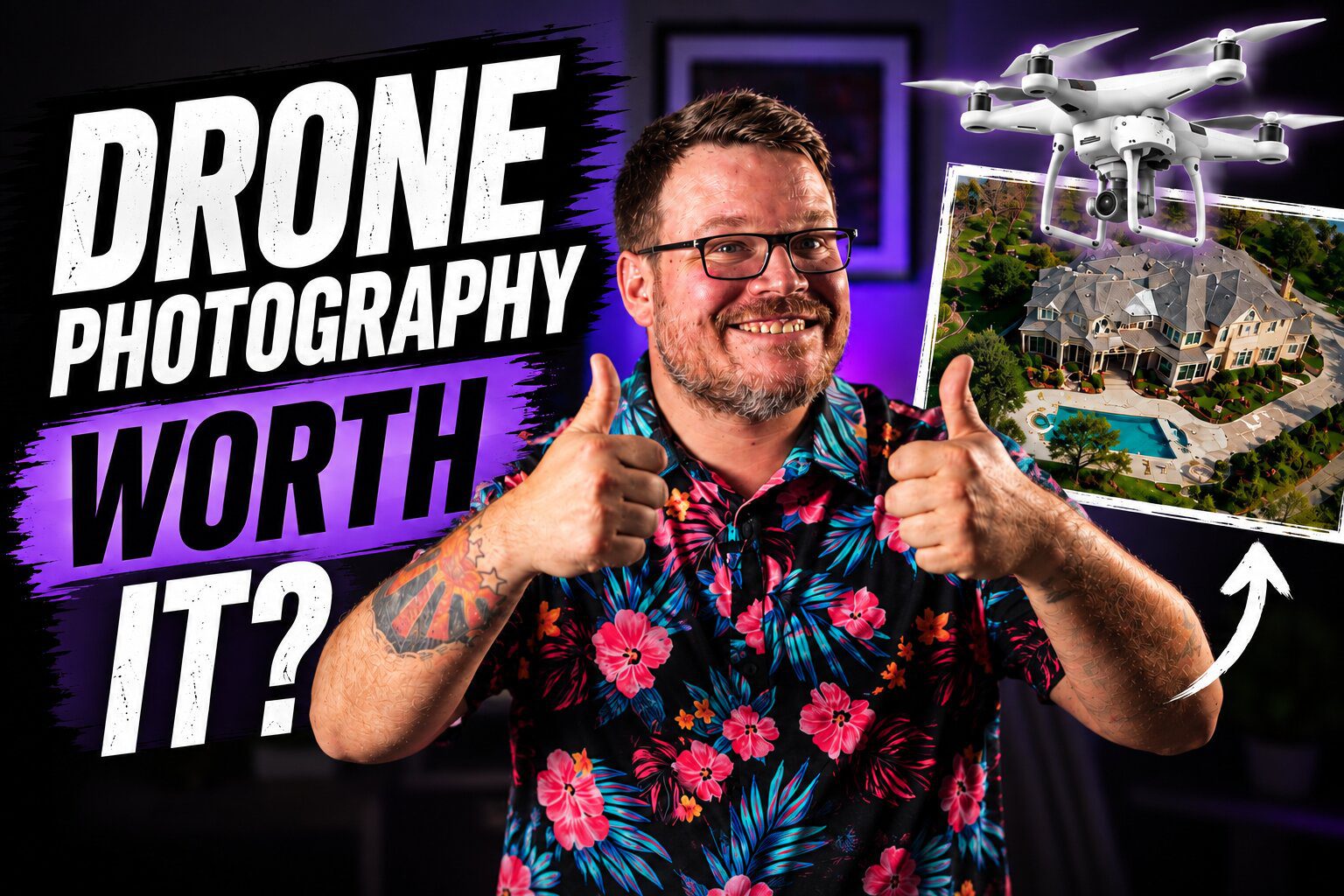
Does Every Listing Need Drone Photography?
A Better Way to Think About Intentional Real Estate Marketing
When people find out that I fly a drone as part of my real estate photography work, one of the first questions I hear is:
“Do you use drone photography on every house?”
My answer is no.
Not every real estate listing needs drone photography. In fact, I think adding drone photos simply because they’re available can be just as ineffective as not using them when they could make a meaningful difference.
That’s because good real estate marketing isn’t about checking every box or creating as much content as possible.
It’s about being intentional.
Before adding drone photography—or video, twilight photos, social media content, or any other marketing asset—I think there’s one question worth asking:
Does this help tell the story of this property?
If the answer is yes, it may be worth the investment.
If the answer is no, you may just be creating more content instead of better marketing.
And there’s a big difference between the two.
What Drone Photography Actually Does
Think about trying to convince someone to visit Yellowstone National Park using nothing but close-up photographs.
You could show them a tree. A waterfall. A hiking trail. Every photograph could be beautiful and technically accurate.
But would they understand the scale of Yellowstone?
Probably not.
Now show them one incredible aerial photograph of the valley.
Suddenly, there’s context.
They can see how the mountains, forests, water, and landscape relate to one another. One image communicates something dozens of close-ups couldn’t.
That’s where drone photography becomes valuable in real estate.
Its real purpose isn’t altitude. It’s perspective.
An aerial photograph can help someone understand a property in a way traditional photography sometimes can’t.
And that leads to the first principle of intentional marketing.
1. Choose Media Based on the Property, Not the Package
It’s easy for real estate marketing to become a checklist.
Photos? Check.
Floor plan? Check.
Drone? Check.
Video? Check.
But two properties can require completely different marketing strategies.
Instead of starting with What services should I order?, start with:
What does a buyer need to understand about this particular property?
Then choose the marketing tools that communicate those things best.
For drone photography, there are three situations where I think this becomes especially important.
Land and Property Layout
If you’re selling a home on acreage, ground-level photography can show buyers the yard, woods, barn, driveway, or other features individually.
What it struggles to show is how everything connects.
An aerial image can quickly communicate:
- How much land surrounds the home
- The relationship between different structures
- Privacy and proximity to neighbors
- The shape and layout of the property
- How outdoor features relate to the house
Even a smaller property can benefit if its lot is an important part of the story—a great corner lot, for example.
Location
Sometimes the biggest selling point isn’t the house itself.
It’s where the house is.
Maybe it backs to protected woods.
Maybe it’s waterfront.
Maybe downtown is within walking distance.
Maybe the home sits on a hill with incredible surroundings.
You can describe those things in listing copy, but an aerial photograph can make the relationship immediately understandable.
Instead of simply telling buyers that location matters, you’re showing them why this particular location matters.
Architecture and Outdoor Features
There are also homes that simply make more sense when viewed from above.
Think about:
- Circular driveways
- Luxury estates
- Pools and outdoor entertaining spaces
- Professional landscaping
- Interesting rooflines
- Large detached structures
One well-composed aerial photograph can sometimes communicate the overall vision of the property better than a long sequence of individual images.
That’s intentional marketing: choosing the perspective that communicates the strongest information.
2. Every Piece of Content Should Have a Job
Before creating any marketing asset, ask:
What is this supposed to communicate?
If you don’t have a good answer, reconsider whether you need it.
A drone photo might communicate acreage.
A floor plan might communicate flow.
A twilight photograph might communicate atmosphere.
A video might communicate the experience of moving through the home.
Traditional photography might showcase individual rooms and details.
Different media have different jobs.
The goal isn’t to have everything.
The goal is to avoid making buyers work unnecessarily hard to understand the property.
Donald Miller puts this simply in Building a StoryBrand: “If you confuse, you lose.”
That applies incredibly well to listing marketing.
Buyers are moving quickly. They’re comparing properties and trying to determine which homes deserve more of their attention.
Good marketing creates clarity.
3. Market the Value, Not Just the Feature
This is where drone photography can go wrong.
A drone photograph isn’t automatically valuable because it looks impressive.
The question is what it reveals.
Take a waterfront home.
From the ground, buyers might see a beautiful house.
From the air, suddenly they can see the house, shoreline, dock, water, surrounding landscape, and how those elements relate to one another.
Now you’re communicating more than a feature.
You’re communicating a lifestyle.
That’s an important distinction to make throughout your real estate marketing.
Don’t just ask:
What features does this property have?
Ask:
Why would those features matter to the person who wants to live here?
That change in perspective can influence everything from the photos you choose to the order of the images, video concepts, social content, and listing copy.
4. Don’t Confuse “More” With “Better”
There can be pressure to throw everything at a listing.
But more content doesn’t necessarily create better marketing.
Twenty additional images that don’t reveal anything new aren’t necessarily more useful.
A drone photograph of a property where the aerial perspective communicates nothing interesting isn’t automatically an improvement.
Another video doesn’t matter if nobody knows what the video is supposed to communicate.
Intentional marketing requires restraint.
Sometimes the strategic decision is to add something.
Sometimes it’s to leave something out.
Instead of asking, “Can we create this?”
Ask:
“What becomes clearer because we created this?”
If you can’t answer that, the content may not be necessary.
5. Remember That You’re Marketing More Than Today’s Listing
There’s another side to intentional listing marketing that agents sometimes overlook.
You’re marketing the property to buyers.
But you’re also marketing yourself to future sellers.
Imagine you’re sitting at a listing appointment and the homeowner asks:
“What are you going to do differently?”
You could tell them about your professional photography, aerial photography, floor plans, video, property websites, and social media strategy.
Or you could show them.
When someone sees thoughtfully marketed listings from your previous clients, they don’t have to imagine the quality of your marketing.
You’ve already demonstrated it.
That’s why the ROI of great real estate media shouldn’t always be measured exclusively by whether one photograph directly caused today’s house to sell.
Maybe the neighbor sees the listing.
Maybe they follow the marketing.
Maybe three years from now, they’re ready to sell and remember:
That’s the agent whose listings always looked incredible.
Your listing inventory becomes part of your portfolio.
A Simple Intentional Marketing Framework
Before deciding how to market your next listing, run each potential piece of content through five questions:
- What makes this property different?
- What might be difficult for buyers to understand online?
- What perspective communicates that information best?
- Does this piece of media reveal something new or simply create more content?
- Will this marketing also demonstrate the quality of my work to a future seller?
Those questions can help determine whether you need drone photography, video, additional images, or something else entirely.
And that’s ultimately why I don’t believe every listing needs drone photography.
The Goal Isn’t to Fly the Drone
The goal of drone photography isn’t to impress people.
It’s to provide perspective.
Sometimes that perspective is incredibly valuable. Other times, traditional photography tells the property’s story perfectly well on its own.
So instead of automatically asking, “Should I add drone photography?”
Ask:
Would an aerial perspective help buyers better understand why this property is special?
If the answer is yes, drone photography stops being another item on a media order.
It becomes part of the marketing strategy.
And I think that’s the bigger lesson.
The best real estate marketing isn’t necessarily the listing with the most photos, the longest video, or the most services attached to it.
It’s the listing where every piece of content feels like it belongs there.
That’s intentional marketing: fewer boxes to check, more decisions made for a reason.
If you found this helpful, check out our work at Madison Creative Media and follow us on Instagram.
We are a real estate media company that offers Cinematic Tours, Photography, Social Content and more!
Based in Bel Air, Maryland
Serving Baltimore, MD & Surrounding Areas

Be The First To Comment